Synthesis and Characterization of Natural Source-Based Hydroxyapatite Composites for Bone Implant Applications: A Comprehensive Review
DOI:
https://doi.org/10.47355/9z709w91Keywords:
Hydroxyapatite, Natural precursors, Biocompatibility, Tissue engineering, CompositeAbstract
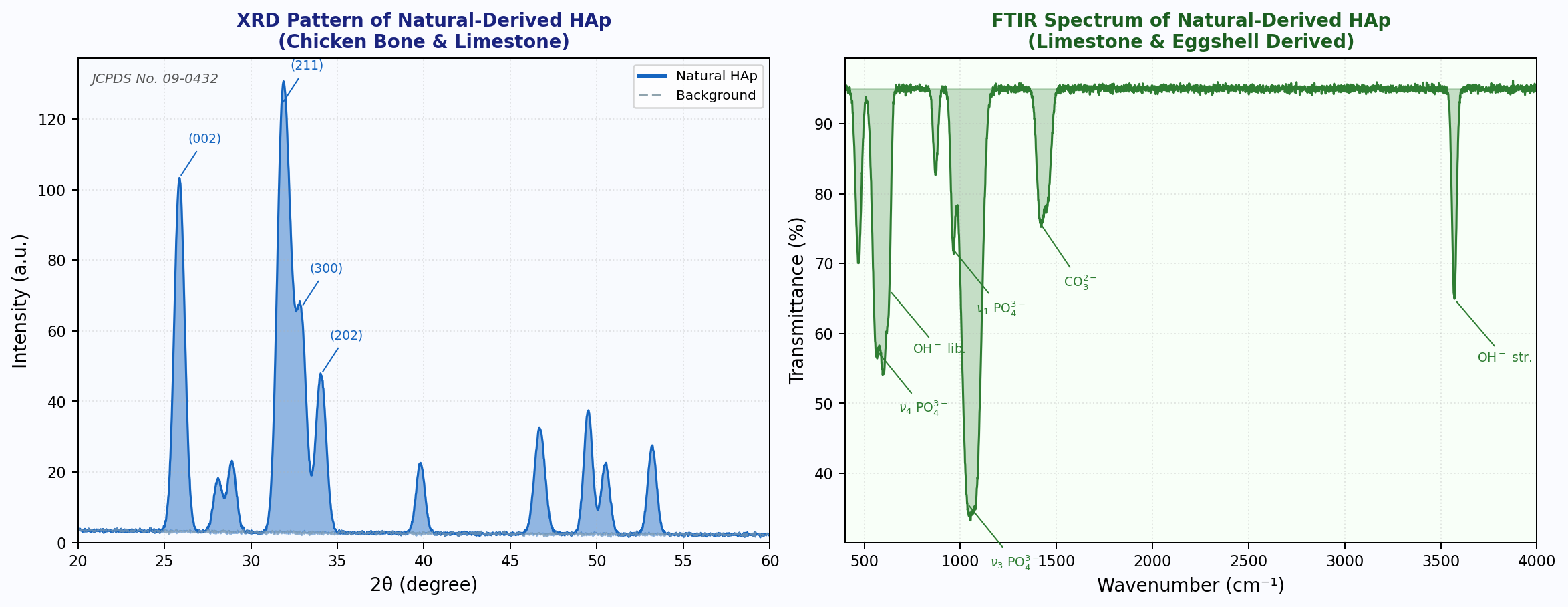
Hydroxyapatite (HAp, Ca₁₀(PO₄)₆(OH)₂) is the principal inorganic component of human bone and has been extensively investigated as a biomaterial for bone implants, scaffolds, and coatings. The conventional synthesis of HAp from analytical-grade chemical reagents is associated with high production costs and limited sustainability. In recent years, natural and bio-waste sources including eggshells, chicken bones, fish bones, bovine bones, seashells, and geological limestone (CaCO₃) have attracted significant research attention as cost-effective and environmentally sustainable precursors for HAp synthesis. This comprehensive review critically examines advances in: (i) synthesis methodologies (wet precipitation, sol-gel, hydrothermal, calcination, and microwave-assisted routes); (ii) characterization techniques (XRD, FTIR, SEM-EDS, TEM, BET, and mechanical testing); (iii) composite development combining natural HAp with biopolymers (chitosan, collagen, PLGA) and metals (titanium, zinc); and (iv) biological performance encompassing in vitro biocompatibility, in vivo osseointegration, and simulated body fluid (SBF) bioactivity testing. Special focus is given to the conversion of geological limestone (CaCO₃) and chicken bone into phase-pure HAp, the influence of processing parameters on crystallinity and Ca/P ratio, and the mechanical and biological performance of the resulting composites for bone implant applications. Analysis of 78 peer-reviewed publications confirms that naturally derived HAp exhibits Ca/P ratios of 1.65–1.67, high biocompatibility (cell viability >90%), and superior or comparable bioactivity relative to synthetic counterparts, establishing a strong foundation for next-generation sustainable orthopedic and dental biomaterials.